By Chuck Park
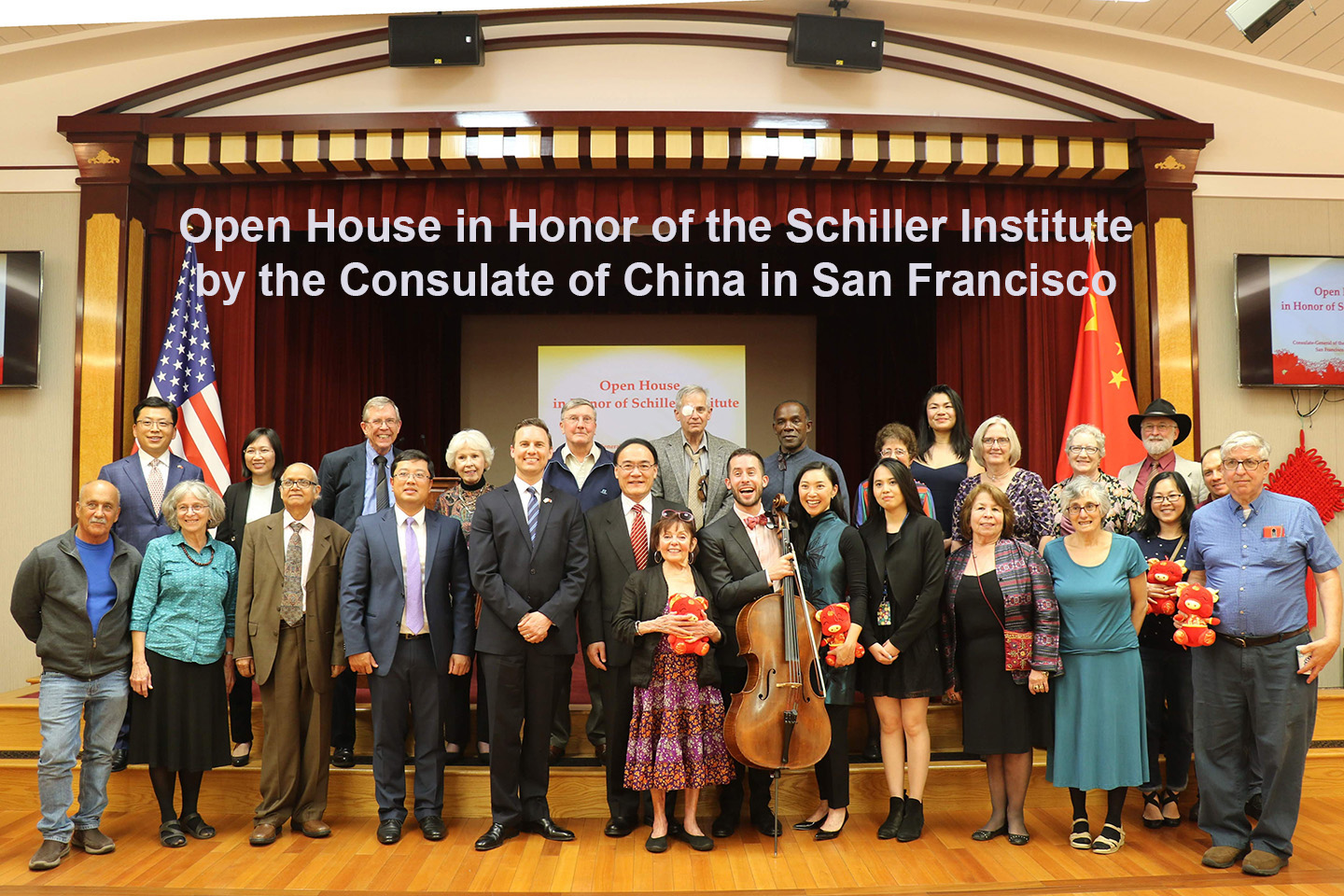
The Schiller Institute brought America to the People’s Republic of China Consulate in San Francisco the evening of June 27, 2019. About 90 people, including the staff of the consulate had a joyous evening of sharp political presentations, great classical music and a wonderful buffet of excellent Chinese cuisine.
The meeting hall of the consulate, as you can see in the photo, had the following on the big screen: “Open House in Honor of the Schiller Institute; Consulate General of the People’s Republic of China San Francisco” 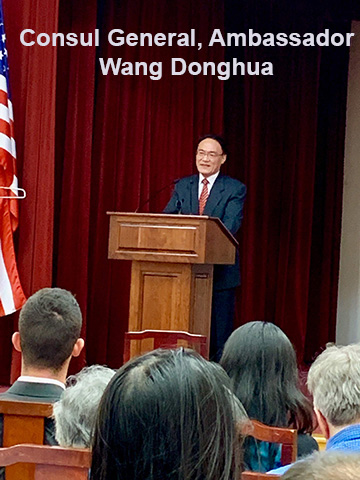
The event began with the Deputy Consul General of China introducing the Consul General, Ambassador Wang Donghua and Schiller Institute representative Michael Steger. He then acknowledged special guests: The Deputy Consul General from Vietnam, a member of the Indonesian Consulate, a member of the East-West Accord, and the President of the Russian American Congress, as well as two local Republican leaders.
As the event coincided with the opening of the G20 meeting of heads of state in Osaka, Japan, the relationship of China and the United States was on the mind of everyone.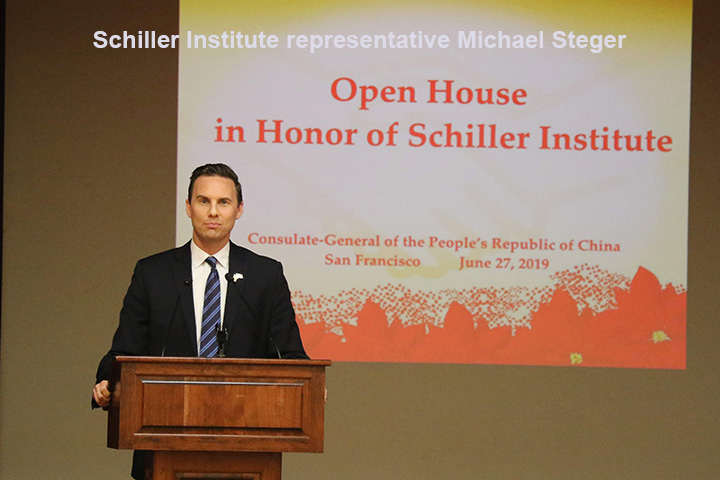
The Consul General then gave a very hard hitting speech expressing China’s frustrations on the current trade negotiations, and made the point strongly that China wants cooperation with the United States, but it will not compromise on anything that threatens China's sovereign interests and system. Of course, he developed for his audience the history and the importance of the Belt and Road Initiative (BRI). Concluding, he welcomed warmly the Schiller Institute and all in attendance.
Michael Steger of the Schiller Institute, next took to the podium and presented a history of the relationship of the United States and China, first telling of how Benjamin Franklin would publish the writings of Confucius in his newspaper. But first, he addressed the broader strategic aspects of the global dynamic, beginning with the introduction of the BRI by President Xi, in consultation with Putin, during the chaotic coup in Ukraine, which points to the role of the BRI to end the risk of nuclear war today.
Steger pointed out that as this is the 40th anniversary of China-U.S. diplomatic relations, it is also the 35th anniversary of the founding of the Schiller Institute by Helga Zepp-LaRouche. She and her husband, Lyndon LaRouche, have been unstoppable during these decades fighting for the creation of a new paradigm of relations among nations, ending forever the British geopolitical manipulations, and putting that relationship among nations on the path of real development. The BRI today, as created by President Xi, is the pathway the entire world must join, especially the United States.
China’s development is a modern miracle and the BRI is a precious contribution to the world that must be grasped now, Steger said. President Franklin D. Roosevelt wanted to shift U.S. war production to develop the world, but his legacy was nearly destroyed in the post-WWII period. Yet, it was Lyndon LaRouche who picked up this fight for global development after WWII; and today, it is China which is making this offer, this precious gift for a new system of collaboration-- for respect of sovereignty, of space exploration and great infrastructure projects worldwide.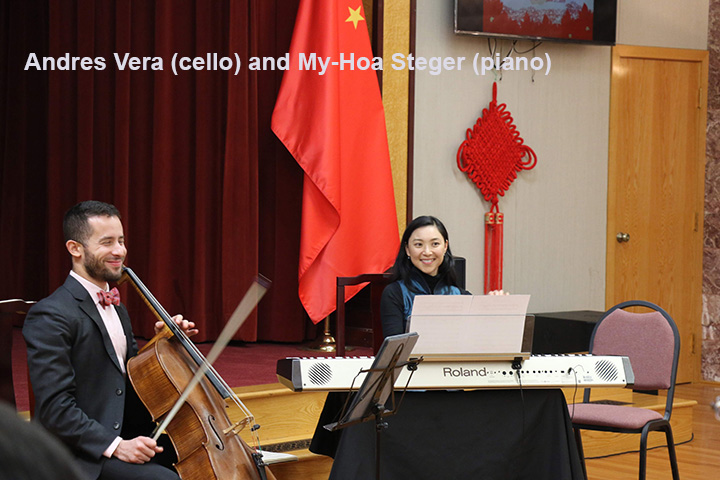
Steger recalled that it was a Russian scientist who once said, space exploration makes most clear the nature of economy-- that money is worthless. It is energy, water, infrastructure, science and culture which are paramount for a new global system, on Earth and on the Moon. This is the BRI-- it is a great gift to the world that must be adopted by the U.S., and it is the very essence of the true U.S. legacy of Lincoln and Lyndon LaRouche.
Concluding, Steger said, so, we all hope and pray that there is a breakthrough at the G20. And if there is, and there may be, will the American policy actually change? Only if we organize the American people to insist that it does. Otherwise, the corruption in Washington will crush any potential for a breakthrough. It is not only up to the leaders, but up to us to create a new culture of development.
With a smile, the Consul General referred to Michael as the representative of the American people, before introducing the music.
To reciprocate the generosity of the Consulate, the Schiller Institute brought Beethoven’s Op. 69 for piano and cello for a universal demonstration on the potential collaborative relationship between the U.S. and China. But before that, My-Hoa Steger (piano) and Andres Vera (cello) played the well known Chinese piece Mo Li Hua (Jasmine Flower) to the delight of our hosts.
Following the beautiful Beethoven work of a genius, a festive celebration of food and discussions throughout the hall lasted for more than an hour more.







The Journal of America Team:
Editor in chief:
Abdus Sattar Ghazali
Senior Editor:
Prof. Arthur Scott
Special Correspondent
Maryam Turab

Your donation
is tax deductable.